The Plot
Sincere teen cutie Rhea (Shraddha Kapoor) finds out her billionaire boyfriend Luv (Taaha Shah) is planning to deflower her and make a sex tape to get points in a rich boys’ contest. (Did anyone say frat party?) Rhea and friends plan revenge. What’s a little John Tucker Must Die between friends? Especially 13-year-old friends.
+3 For the stop-motion fun in the opening credits. Watch those T-shirts.
+7 For the most accurate war for teengirl-speak in years. Thank you, director Bumpy. Umm... minus three for same. People have to stop saying dude, woah, babes, chill. And Bumpy.
-2 For the queen bees. Those who customarily haunt corridors of filmi schools/colleges, have to stop channelling Mean Girls now.
+5 For Archana Puran Singh’s wannabe-cool mom entrance. She’s still got her fingernail scratching a blackboard quality to her voice.
+5 For Rhea’s mother’s accurate stuck-but-stoic-between-generations character. Lots of mums nodding right now.
-10 For ‘don’t lose it in the backseat of a car’ and other 30 paisa xerox copy dialogue.
+7 For the ‘enter password and da, it’s Karthik’ sequence. On such slender pleasures are our geek lives made.
-10 For laxatives and itching powder for revenge. Plus five for a car smashing the girliness of which has only been surpassed by the models’ petrol fight in Zoolander.
+6 Because Rhea smiles and bawls like a teenager. She looks so pretty when she says, “I will have your balls.” No points for boyfriend Luv because we have already forgotten what he looks like.
+2 For jugs (Pushtie S). “Come on Rhea, 50 percent India aise sadak pe sota hai.” In her abrasive fat girl role, she has many good lines.
-5 For the climatic scene for making us think of the sins of the fathers — someone threatening Shakti Kapoor’s daughter with rape. And a fake accent. Plus five for her unceasing glare and self-rescue.
+5 For film ka the end because every teenage girl must make out with Ali Zafar.
+ 10 FOR CREATING A NEW DRINKING - 10 FOR THE MOST ANNOYING, + 6 FOR THE BORDELLO + 5 FOR THE ROTATING RED BED IN + 3 FOR MAKING JON HAMM THE - 10 FOR CREATING THE MOST + 10 TO CINEMATOGRAPHER LARRY - 10 FOR KILLING THE + 5 FOR DISCOVERING EMILY BROWNING, - 6 FOR NEVER EXPLAINING TO US,
game. Is this movie Inception meets Shutter Island meets The Baby-Sitters Club? Or is it The Baby-Sitters Club meetsShowgirls? Or is it Baz Luhrmann’s Matrix meets Afro Samurai? So many lovely ways to lose consciousness while watching this movie and you will want to.
metaphor-heavy, cringe-making voiceover ever. Luckily, it pops up only in the beginning and the end. So plus five to Zack for that decision.
loving imagination of the unreliable narrator Babydoll. Combined with the unreliable narration of writers Steve Shibuya and Zack Snyder, all you end up with is head-scratching.
the bordello because what is a bordello without girlish camaraderie, golden-hearted whores and a rotating red bed?
doctor who lobotomises mad girls. As Tina Fey says of his 30Rock character: so handsome!
dull quests for the girls, making you miss action sequences ofSuper Mario Bros or was it Prince of Persia? Perhaps Pac-Man.
Fong for creating the rich, burnished look, that is the only reason for you to keep watching. (This despite the presence of five pretty girls in short skirts and sexy Carla Gugino as Dr Gorski, the Madam of the brothel.) Thanks to Fong, every scene looks like a page out of a comic book you want to buy.
gallant Rocket (Jena Malone). Of course, the moment we saw her kind eyes and determined little chin, we knew she was going to be offed but still. Also, why didn’t Snyder have any suicide girls in the troop instead of this all-American girl band?
who plays blank-faced Babydoll. Fourteen-year-old boys everywhere will always love the violent hottie and thus the order of the world is maintained. The rest of us geriatrics think the surprise element of the wee little girl vigilante began with Buffy and ended with Kick-Ass.
even in the end, why Babydoll (Emily Browning) is Super-Babydoll. We like, we love back stories for ass-kickers, even if you could only squash them in a single panel in the end because of the vaulting ambitions of your narrative.

If you enjoyed Wag the Dog, you should watch In the Loop, a political satire that makes Wag look romantic. Everyone is corrupt, everyone is weak, everyone is funny. Oh and there's James Gandolfini.

There's nothing quite as wonderful as the corny opening lines and voiceovers of noir parodies.
Sondra Stingray: Sapphic Gumshoe from Reel 13 on Vimeo.

GODDESS LAKSHMI appears bejewelled, curvy and sloe-eyed out of a watercolour sea on a pink lotus. A peacock gramophone appears next to her and she begins dancing to the sound of 1920s blues singer Annette Hanshaw’s Moaning Low. Nineteen seconds later, the record gets stuck at the phrase ‘a woman like me, a woman like me.’ She cocks her ear to the record and the scene explodes into the opening sequence of artist Nina Paley’s Sita Sings the Blues.
In 2002, Paley (now a Guggenheim fellow) followed her then-husband from the US to Thiruvananthapuram, Kerala, where she read her first Ramayana. When she was back in New York for a week, her husband wrote to her, asking her not to come back. This part of her life and grief runs as a parallel track in the film. The main narrative examines, with a sceptic’s eye, Rama’s behavior towards Sita. Paley wrote, animated and produced the film singlehandedly over five years on a home computer. The results are extremely charming.
The autobiographical strand of the film follows a rather uninterestingly told narrative of self-actualisation, of the wronged woman who finds herself in work and art. But Paley doesn’t attempt such an interpretation of the Ramayana. Instead, like the many Sitayanas sung and narrated by women across India, the film tells the story of a lovelorn and devoted Sita and criticises Rama’s actions, sometimes upfront and sometimes with sly wit. Paley’s Sitayana, full of surprise and variation, is populated by one-eyed flying demons, a double-bass playing Hanuman and a Fred Astaire- like tap dancing moon. Mocking the limitations of 2- D animation, her characters spring perfectly to Hanshaw’s songs. Now that Paley has made the widely-admired 2008 release freely available online under a Creative Commons License, groups in India are beginning to organise public screenings. Understandably, they are nervous.
It doesn’t matter that Paley’s version is told with palpable love, and a desire to remind people that some kinds of pain are universal, transcending time and culture. Organisations like the Hindu Janajagruti Samiti (whose identity can be measured by how easily they’re offended) have objected to its existence. On their website, fascinatingly named Denigrations, the Samiti urges people offended by the film to file police complaints. An open letter tells Paley that she doesn’t have the spiritual maturity or authority to ‘twist’ a story. Also tacked on is the now popular, and confusing, threat that offended Hindus will follow the path of violence that fundamentalist Muslims did after the Danish cartoon controversy.
Part of this film’s charm lies in the fact that Paley isn’t smug, or doesn’t pretend to be sure of the ‘purity’ of an epic. Sita is occasionally Betty Boop-like with circular fringed eyes, sometimes like a Rajput miniature and sometimes like calendar art. The most commonly known interpretation of the Ramayana, the one many of us are taught as children as the authoritative story, plays out over 82 minutes. Meanwhile, three shadow puppets with urbane desi voices argue mildly about the sequence of events and the motivations of each character. Was Ravana a good guy? Was Sita wrong to refuse to be rescued by Hanuman? What was Rama thinking? Was Sita wrong to love a man who didn’t trust her? No, Sita loved Ram unconditionally. Heavy ground is covered swiftly and lightly, leaving you with the blues and sweetness.
Reading our cultural guardians’ spewing of bile leaves with you with far less elevating thoughts.
From Tehelka Magazine,

Is it my imagination or is there a Fridaesque effect here?

It has been a year and I have watched Jhoom Barabar Jhoom five times, I think. I am convinced that JBJ's poor marketing has led to a great loss for the viewing public. Instead of being marketed as the anti-NRI romantic comedy, the trailers only had those great, goofy dance sequences.
Even BI who thinks literally everything is a good idea blanched at the idea of watching JBJ and had to be bullied into it. You, my barbaric readers, are more open-minded people. Go and watch the damn thing. Enjoy the repartee, enjoy the surreal pace, cry over the Humayun Tomb and speculate, like I frequently do, about what Shaad Ali on while making this movie.
Are you kidding me? A Hollywood film with Charlize Theron about the WTO protests? I mean like what? The Stuff White People manage to do astonishes me.

Yesterday watched Rock on and Padre Nuestra one after the other. Should have watched in reverse order. Rock on was as slick as (to borrow Spellcheck's phrase) as a used condom falling into an oil slick but also silly in bits. I mean Zahreela, Neela, Peela... lyrics from a 90s Bangalore rocker? Sorry Saar! Farhan Akhtar's character brought to mind some lively S&M possibilities (imagine what ang lee would have done with him) but the most sexy thing on screen was Shahana Goswami.
Is it just me or were the level of attention to interiors and costume just distracting after a point. Particularly in Aditya and Sakshi's home where I was convinced I saw a menhir that Obelix had lost. And a loft? In Mumbai? A loft? And why werent ten families squatting that basement? Sorry to become annoying realismvangelist... i am not usually... but something about those interiors....
Padre Nuestro was a super depressing, but enjoyable Mexican film. It's coming to the PVRs so you should be able to catch it. Great pace and full of surprises. It was a little too neat in its plotting... but nevertheless interesting.
Okay! So off to Guwahati. Manipuri colleague said (while laughing!) that the place I was going to stay in (in Imphal) has been bombed. Jolly. So much easier to sit in Delhi writing rubbish. Guwahati of course is a very different game. It has Coffee Day. Pappu asks why people dont bomb Coffee Days instead. Oy!

You know all those times when you read that someone had stripped for a movie because the sex was integral to the script, and you giggled? I defy you to giggle after watching Lust, Caution. The movie is very pretty but comes to life during the ten minutes of sex between the young spy (Tang Wei) and the evil traitor (Tony Leung). The sex is beautiful, painful, clumsy, acrobatic, arousing and also the ten most insightful minutes about the two protagonists.
Tony Leung is so attractive (in the true sense of the word) you wait through the movie for any sign of humanity. And when it comes, in bed, you are so deeply grateful.
This weekend I rewatched Ang Lee's Sense and Sensibility. Again, a neat pretty movie, perfectly cast, with the most perfect five minutes when all the neatness and prettiness falls apart. Its so satisfying to watch Fanny Dashwood screech and leap across the table to grab Lucy Steele's nose.

If you love Frances McDormand then this is a fun movie to watch. Its a tiny little film but Bharat Nalluri somehow manages froth and poignance. It is a bit too heavy-handed to reach the Anita Loos-meets-PG Wodehouse levels of lunacy it was set to meet but still is quite wonderful. Amy Adams channels Lorelai Lee so hard that her shoulder wriggles are totally out of control. Watch it especially if you are into period froth.
Working on Sundays makes me grumpy and I still haven't got my mojo back but you should go watch Khuda Ke Liye.
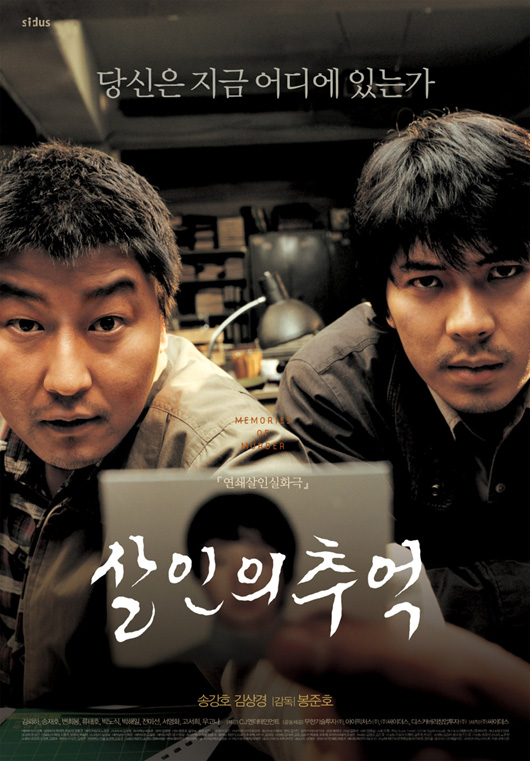
Bong Joon-ho's Memories of Murder is one of the most satisfying movies I have seen in ages. This movie precedes Joon-Ho's brilliant monster movie Gwoemul and has much of the same cast. Unlike Gwoemul it's set in small-town Korea in the late 80s.
A group of policemen with vastly varying degrees of competence try to track down a serial killer.
Joon-ho has a true gift for the comic but what amazed me is how much of the incongruous seemed completely plausible to me as an Indian. In one sequence, two cops who had been torturing a simpleton to force a confession are seen sitting in front of the television. All three sit side by side watching television, eating vast quantities of food and commenting gleefully about what's on screen.
The tension is beautifully maintained but with the tiniest of touches Joon-Ho shows that its possible to make a movie about sex crimes without being voyeuristic. He also creates the disquieting but compassionate notion that thinking violence is not the same as doing it. Suspect after suspect turns out not to be the killer but several of them do nurture elaborate rape fantasies. In counterpoint, a policeman (one of the few competent ones in the film) is in a high school talking to a pretty young schoolgirl. She is in the school clinic looking for a band-aid to stick on a scratch on her back. When the policeman offers to do it for her, she balks. The policeman tells her, "Feeling shy, why? You are just a child".
To me this is the moment in which Joon-ho takes this American genre (in which the policeman must have a lecherous moment or two around a precocious piece of jailbait or a sexually active woman thus supposedly creating moral ambiguity about the violence) and returns it to the world with watercress (or possibly kimchi) around it. Take that, you idiots, he seems to be smirking.
It doesn't hurt that it's beautifully shot.
7 am is a barbaric practice. Paying a 1000 rupees to travel 40 km in a matchbox is barbaric. Journalism is barbaric. Tandoori chicken and its variants are barbaric. This land is meant for___ (insert rude local name for community that your mother looks down upon and you only utter in your most private thoughts)
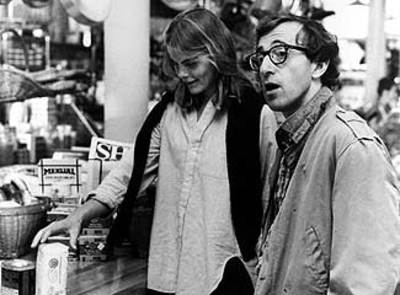
I want to lie at home and squirm in embarrassment as I watch Manhattan again. If that movie did not have the shaming honest face of Tracy (Mariel Hemingway), would it have worked at all? I suspect not. It would have only been what that man in the Telugu movie said, "You dance, I glance", a formulation Schopenhauer would not have been ashamed of.
To stay on the subject of porn and good cheer... The Notorious Bettie Page is a wonderful movie. The original Ms Page was a one-of-a-kind creature. In the 1950s she was famous equally for her cheesecake photos as well as for appearing in bondage magazines. In 7 years she appeared in more magazines than Marilyn Monroe and Cindy Crawford together. She did some Broadway plays, was an early Playboy pinup and then disappeared from the scene. In the 70s she somehow became a punk icon. More recently she is the star of some (rather boring) comics.
Bettie Page Gretchen Mol as Bettie Page


Very few of the fetish films she did survive today because of a government crackdown (just after which, she disappeared) but to even see one is enough to embrace her goofiness. A goofiness that director Mary Harron and Gretchen Mol brings to a movie version (shot partly in colour and partly in black and white). I don't like ingenues but Gretchen Mol who plays Bettie Page is the messiah of ingenues. She reclaims girl-next-door. She is the orange juice and sunshine that would make you shed your black lipstick and Malayalee boyfriend with a rock band. She and a completely sweet cast of characters make a surprisingly heartwarming movie. Not that the director of American Psycho can make a sentimental movie but this is It's a Wonderful World for pomo-addicts.
There have been complaints that this movie ignores the seamier side of the porn business. Harron's interpretation is gloriously free of judgement but it is not Disney. I think it would be a mistake to take Bettie's naivete at face value. It is in the texture of the movie (its ironic use of music, its refusal to create an artifical moral resolution) than in the naivete itself that you see Bettie's courage and in turn Gretchen's courage. JM Coetzee asks in an essay on Clarissa what the appropriate response is for a man to soul-wrenching beauty? In Bettie's case her geeky photographers are awed and gratified at her ease and enjoyment of posing nude. In one crucial scene Bettie (on an impulse) posed nude in a sunny park for a photographer. Many reviewers' response to this scene has been an identical awe and gratitude to Gretchen Mol.
Gretchen Mol has an unusual story too. She started wonderfully. Discovered by a talent scout when she was a hat-check girl she was catapulted into movies. Woody Allen, Spike Lee, named IT girl, then came a Vanity Fair cover where her nipples showed through her dress. This cover is said to have started a round of gossip which basically translated to 'girls who show skin probably can't act'. And that was that for a good long time. After doing a lot of bit roles came this movie. If you watch her in it, you can't imagine anyone else playing Bettie Page.
A sequence from The Notorious Betty Page
Silly Footnote: Throughout the movie I kept thinking that somewhere Andrea Dworkin and Catherine Mackinnon must be sticking pins into voodoo doll of Mary Harron. Then I read in an interview of Harron that one of the reasons she made the movie was because she was inspired by the experiences of her actress stepmother Catherine Mckinnon. I choked for one minute then realised that this was a completely different person.

A James Bond movie marathon. Can there be anything more wonderful? All the cheesiness, all the corny pick-up lines, the globe-trotting, the discovery that every house has a man who has watched Goldfinger six times... surely nothing can be a better pick-me-up. In my scheme of things, it has been as good as the afternoon two young ladies and I watched (back-to-back) one soft porn-movie, Caligula and When Harry Met Sally. (However I may outvote Bond after watching five versions of Pride and Prejudice back-to-back.)
Some movies do require more stamina from viewers than the others of course. Live and Let Die is so incredibly racist I was not sure whether I wasn't watching a spoof... Undercover Brother Returns perhaps. Pierce Brosnan, whom I like otherwise, seemed to have been in the most tiresome Bond movies. Sean Connery is positively villainish. I forgot. Bond-marathon-fun includes all the endless speculation about which Bond was better. I have never particularly cared so far but I came screeching to a halt with Daniel Craig.
Brutish, bull-necked, plainly a prole in a dinner-jacket, changing Bond before my very eyes... forcing a Bond movie to have a narrative. Shocking. With the addition of the most beautiful woman in the world, Eva Green, I vote the new Casino Royale the best one so far... of course there are other Bond movies that are simply more fun to watch, because they are more solidly in the B-movie genre. But decades from now, when I have another bad week that can be fixed with a Bond-movie marathon, I will thank Craig for making me join half the human race. The half that has strong feelings about Bond movies, I mean.
Here is Craig making a very different kind of entry.
The second sequence is a very lovely piece of animation and also has killer music

In the final scenes of Terry Pratchett's Moving Pictures, new Discworld movie moghuls CMOT Dibbler and nephew Soll watch a huge image of a woman (a 50 foot image, to be exact) carry the Librarian (who is an orangutan) up a tower. As they watch the giant woman carrying the ape, they both remark worriedly to each other that for all its spectacular value, something was not quite right about what they were watching.
I've had similiar feelings about most monster movies. It has been difficult to decide which one is a worthier candidate to despise, Jaws , Godzilla, Jurassic Park or that intriguing turkey of a movie, Anaconda. Therefore, I have largely contented myself by not watching them. (King Kong is different because it taps into a bestial, sexual vein in its loopy way).
Last night, quite by accident, I found myself 20 minutes into a monster movie before I had realised it was one. Gwoemul (The Host) is a Korean movie which elegantly lets you know that Hollywood should shut shop and find other pursuits. Gardening, perhaps.
In Gwoemul a mortician in a US Army base in Seoul is ordered to pour toxic chemicals into the Han river. A few years later, fishermen spot it. Later, an acerbic suicide spots it in the river moments before he jumps in. A while later, the monster, inevitably, attacks. Simple-minded, lazy Gang-du is caught up in the attack and his little daughter is one of the people the beast carries away and is seen eating. Seoul is whipped into a panic by the US and by the media about a virus that the monster carries. Since Gang-du had come in contact with the monster he and his family are quarantined. While in quarantine, Gang-du gets a call - from his daughter. For the rest of the movie, Gang-du, his father and siblings try to get the little girl back.
Gwoemul works on many counts. The beast (large, though not Kong-size) conveys both bestial agility and a degree of intelligence that makes it quite possible for you to scream without embarrassment. And no matter how much airtime the beast gets (quite a lot, and in daylight) you rarely have a moment to register that it looks preposterous or even think cynical thoughts about special effects. Too much is happening on screen for any of that. Gwoemul has the basic monster plot and a fabulous, eccentric narrative. Important, interesting, well-developed characters (people you root for fiercely) die, so you wll have actual reason to panic and even weep, rather than wince. And as if this wasn't enough. Joon-ho Bong, the director also displays a deft hand at introducing a great background score, at pure black comedy and at enough US-baiting for North Korea to give an unprecedented stamp of Commie approval to this, the highest-grossing South Korean movie ever. Bong has thoroughly enjoyed himself making this film. Look at the eyes of the American doctor who comes to talk to Gang-du in the last half-hour of the movie and you will know what I mean.
