

 Even if lovely Prashant Miranda was not featured in An Illustrated Life, I would want it. This is a a gorgeous compilation of illustrators' sketchbooks from around the world. More info on Prashant's blog.
My birthday is in June.

Wedding Night
I am watching Buffy all over again after a few years' gap and not amazed but definitely thrilled at how well it still holds up. Still funny, still spooky, still relevant.
It's good to hear that Joss Whedon has a new show coming up. It stars Eliza Duchu who played Faith. I have always liked her.
I was also checking out Whedon's entertaining online comic Sugarshock. Within each issue the comic is easy to navigate but finding the next part is fairly difficult. I am including the links to parts 1, 2 and 3 here.
Talking of comics, Chitra Ganesh's new show is opening this week in Chatterjee and Lal, Colaba this week. I would go if I could. I had written about Chitra's Amar Chitra Katha-inspired work here but she has other work just as sensational.
Joss Whedon would love Chitra Ganesh.

Helmut Newton's1994 shot of Nadja Auermann for Vogue, an image cited by a desperate person as one of the reasons Vogue under Anna Wintour was/is different from the rest of the fashion pack. Cathy Horyn laughs.

Is it my imagination or is there a Fridaesque effect here?
There is simply so much Palin stuff online it boggles the mind. I've watched the surreal bikini round over and over again. After a week of watching Spellcheck play his Tina Fey bits I can barely tell the difference between her and Palin. Last week this site, the Sarah Palin Oval Office, so horrible and basic, would have been amusing. But now with the margin narrowing betwen Obama and McCain, it's just depressing.

Takashi Murakami's Hiropan
Rakhi Sawant's Rakhi Sawant

Chitra Ganesh, Tales of Amnesia, Ghost
Dhruvi Acharya, Words III
The story about Amar Chitra Katha was great fun to do especially because everyone I talked to also seemed to be having a good time.
WHEN ANANT PAI, an engineer from Karnataka, started Amar Chitra Katha in 1967 he wanted to bring entertainment into the dull lives of schoolchildren. He and the team that worked with him in India Book House created a runaway success. Gods, humans, demons, saints and revolutionaries frolicked, fought and loved within brightly coloured panels. Equally acceptable to children and parents, Amar Chitra Katha (ACK) was to become an authoritative source for Indian mythology. Everyone from costume designers of mythological serials to school teachers and trivia hounds saw familiar and unfamiliar tales through the ACK lenses. The selfstyled Uncle Pai was told decades later by then prime minister Atal Bihari Vajpayee that only he could fill the warm spot left empty by ‘Chacha Nehru’.
Though just as ubiquitous as in their heyday, the comics are today discussed with nostalgia by thirty-somethings, spoken of in the same breath as Amul hoardings and the “Ek chidiya anek chidiya” national integration jingles — benchmarks for an object’s transformation into cultural artifact. But, art and academia are suddenly giving ACK new attention disconcertingly devoid of nostalgia.
Nandini Chandra, a Delhi academic, has spent the last 12 years studying the ACK as a text and an institution. She says while the aging Pai remains an avuncular, chatty man with a sincere interest in education, the ideological underpinnings of ACK bear much closer scrutiny.
Chandra, writes in her new book The Classic Popular: Amar Chitra Katha, 1967-2007 (Yoda Press) that every ACK fan would benefit from understanding how the comics conflated the Hindu with the national. Chandra makes a convincing argument that the comics combine relatively innocuous text with far more troubling visuals. The bearded Muslim and the dark-skinned person are rendered stock villains in a vast majority of the 600-odd original ACK titles. Women characters enjoy emancipation in the narratives but are framed so that their bodies are viewed through the eyes of the ravishing villain. Lower caste heroes and saints are pushed to the margins by Brahmin characters.
Yusuf Lien aka Bangalorewala, ACK’s lone Muslim painter, whose poignant Mirabai won awards, eventually found the ill-concealed propaganda too much to work with. “Muslim freedom fighters and Aurangzeb were sidelined and ‘grey-zone’ mystics such as Dara Shikoh and Kabir were chosen as representatives of the Muslim,” he told Chandra.
AS YOU READ The Classic Popular and look at the strips again you are first amazed at how much you remember, and then because you had not noticed these obvious details before. “When I first started rereading these comics I was startled at how insidious it was myself.” But Chandra also says that by creating a corpus of folk tales and local history ACK artists and writers inadvertently subverted the monolithic national vision for a more nuanced perspective.
While the politics of ACK would worry a careful reader others look past the manipulative content fondly. Hyderabad-based comics collector Satyajit Chetri is one such fan. Two rooms of his home have been set aside for several thousands of contemporary and vintage comics from around the world. These include 500-odd ACKs. Chetri says, “My interest in comics began because of ACK. I used to find them useful for quizzing and then I really got into them. As an adult I look at them more critically and can see how the comics are biased. But ACK is still very cool because of all the research they did.” Chetri adores the hard-to-find original ACKs and even harder-to-find early comics which were printed only in blue, green and yellow. It distresses him, the proud owner of an original watercolour by Japanese manga artist Goseki Kojima, to hear that ACK lost their original artwork in a fire.
Chetri, a serious fan, even made a pilgrimage to Mumbai to see Pai. Though thrilled to meet Pai, Chetri is also fascinated with the late Ram Waekar, one of the handful of artists who created the look of ACK. To Chetri, Waekar is like Steve Ditko, the co-creator of Spiderman who was overshadowed by his partner Stan Lee. “His women were beautiful. His drawing style has wonderful, clear lines.”
One of the greatest pleasures in reading Chandra's book is the introduction to the minds behind ACK. Not quite as dramatic as the events of graphic novelist Will Eisner’s autobiographical The Dreamer but fascinating nevertheless. Through this she also traces the visual vocabulary of individual artists. Calendar and poster art, Modesty Blaise, American thrillers, the Peruvian artist Boris Vallejo all combined to create iconography in ACK at once bland and incendiary. It is from Chandra we learn that Waekar first drew a bearded Ram in the Pothi traditions of his homestate Karnataka. He was immediately asked by Pai to redraw Ram in the Ravi Varma style. Waekar, who was just as shrewd, drew on other acceptable sources, which is why we see in one Waekar panel a Ram who bears a striking resemblance to Johnny Weissmuller in Tarzan. It was also Waekar who established the ACK convention of fair complexions for gods and human beings while depicting demons as universally dark.
Though the comics were clearly influenced by Hindi cinema’s framing, the artists generally looked down upon the industry. This is despite the fact that one of the ACK artists, CM Vitankar, was formerly one half of a film-poster painter duo, Thakur-Vitankar, a pair so celebrated for their work that movies were released months later to match their schedule. .
During the time Chandra worked on this frequently grim book, she would have been cheered to see artist Chitra Ganesh’s work (now showing at Chatterjee and Lal, Mumbai). Ganesh too probes the tension between the words and imagery in ACK. Ganesh integrates fragments of the originals with pen and ink drawings and replaces the text with her own lyricism.
A first look at Ganesh’s Tales of Amnesia, a 21-part comic series, does not reveal anything unusual, so familiar are we with ACK or, more likely, with the memory of it. Look again. Dark nipples, heads on ritual salvers in the hands of gentle ladies, a woman performing oral sex and monstrous bodies composed of fragments of the pink limbs that all ACK heroines had.
Ganesh is a 33-year-old Brooklyner, who like thousands of others, had read ACK comics when she was a child, picking them up both in New York and on family trips to India. Some years ago she revisited them as an adult, “I was at a residency and my girlfriend at the time mailed me a care package with some comics,” she said. “ACK comics disseminate prescriptive models of nationalism, religious expression and sexuality. I’d like to create mythology that poses questions rather than clear answers.”
Unlike the weepy yet amusing women who feature in Roy Liechtenstein’s work (an artist Ganesh is often compared with), the heroines of Tales of Amnesia are violent, volatile creatures escaping ACK’s Lakshman rekha. In her book Chandra has an irritable passage questioning how Pai arrived at ACK’s now famous costumes for women. Channeling the spirit of Raja Ravi Varma, ACK was able to conceal the sensual in the divine — in knotty, diaphanous garments. Chandra, when she finally encountered Ganesh’s work this week was gleeful. “I am so glad the breasts are popping out in her comics.”
Dhruvi Acharya, a 36-yearold painter, also engages with the disjunct between art and text in ACK. But she has gone in the opposite direction from Ganesh. In her Words series (now showing at Chemould Prescott Road, Mumbai) Acharya has kept the ACK blurbs but erased the images. Detached from the panels they are ridiculous. “How strong and firm is his grip,” says one. Acharya, whose art usually radiates cool wit, gives in to a rare snigger.
In the West once beloved figures like Enid Blyton have been reviled for political incorrectness, banned from bookshelves and children. In India Chandra’s book may cause some disquiet among very scrupulous parents. But Chandra says that she admires ACK for what it is and sees no reason for exile — just some distance. She says, “ACK was avowedly for children but the creators knew that adults were the actual buyers. They needed to be amused and interested first. There is also a clear understanding that children are canny and don't need to be protected. They need to learn that the world contains evil and duplicity.” It is unlikely that Pai foresaw that his immortal picture books could one day be displayed as object lessons in duplicity.

The Chinese artist Cui Xiuwen has art that, I imagine,  Buffy would like to hang on her walls. Her bloodied school girls are in turn vulnerable and spooky. What does it mean when the same figure is multiplied across an artist's canvas and across most of the artist's works?
Yue Minjun, Execution
Farhad Hussain, Untitled
Cui Xiuwen, Sanjie


I've been reading about W magazine's old shoot of Angelina Jolie and Brad Pitt recently. This shoot was cited was yet another sign of insensitivity from Brad Pitt to Jennifer Aniston with whom he had just broken up. Steven Klein's feature Domestic Bliss turns out to be quite interesting. It's as if one of the Brady Bunch kids married Morticia Adams. Sample some of the delights. But this exercise in irony is rendered hilarious three years down the line when the object called Brangelina is in full flower.

You know my heart is with NS Harsha but I could love Manjunath Kamat just for this. He is like Kay Ryan in watercolour. More on Masala Chai's delectable blog.
Oh, I have always known Bent is a genius but here is evidence. He has been very into this particular shot by photographer Sunil Gupta for a while.
Yesterday it struck him that the reason he likes it so much because it reminds him of this still from the Issac Julien movie Looking for Langston.
My talents are relatively minor. It involves chasing the bees in Bent's bonnet. So this fine Sunday morning I decided to look up both images. As it turns out it was the beautiful Sunil Gupta who shot the stills for Isaac Julien's movie in the first place in 1989.
Like I always said, I have always known.

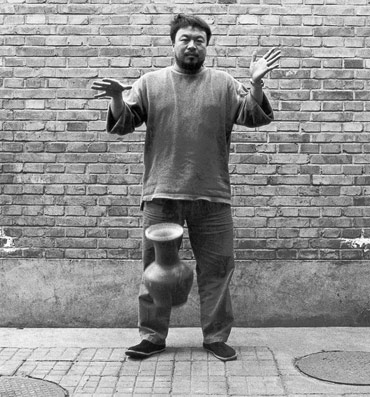
Bad, bad Ai Wei Wei. Good, good boy. Paint coke labels on han vase and smash it. Work on the Olympics stadium and give it the finger. At the very least you make great copy. And you really sock it to the government.
Here's a blog that had me going awwwww just because of its name. Which Main? What Cross ? has a collection of photographs from Bangalore that makes me feel all warm and tingly.
Here is one of Blossom.

and one of Lal Masjid Road

and one of Murphy Road

and Johnson Market!!!


I am following Savita Bhabhi's progress with great interest. In the last strip she has acquired an attractive but taciturn husband who she can cheat on with our blessings. The last strip even give her a bit of a bitchy streak. But in the newest strip she has returned to being the idiot ingenue. She's just realised that 'her cousin took her virginity'? Seems a bit dim, what? But its porn and its fun.
If you have somehow missed the Savitha Bhabhi storm read about her here.
There are some writers that you always associate with the person who first introduced you to them. When I read Elmore Leonard I always think of Bent. He lent me all the Elmore Leonards I first read. When I saw this I knew he would love it.
This book is catnip for any Elmore Leonard fan. For non-fans too I suspect the book would drip with cool. Leonard's laconic prose is stripped to maxims and is illustrated by Joe Ciardiello. Ciardiello's work, particularly his illustrations are great fun. I was looking for more work by Ciardiello and stumbled across his work in an exhibition of major American illustrators. In You Must Have Been a Beautiful Baby you can see some hilarious self-portraits by legendary artists depicting themselves at some point between birth and puberty.
Joe Ciardiello
Jim Bennett
Teresa Fasolino
Some odd conversation with Bottle Imp started me thinking. Who is my favourite character in Indian writing in English? I don't know! It should be shocking but it isn't... what characters has IWE thrown up so far that you feel attached to them afterwards... as if they meant anything.
My responses surprised me a bit.
Akilan of No Onions Nor Garlic ranked very high.
YoungUncle from Vandana Singh's series
Toby from one of the short stories in Nalini Jones' What you call Winter
Sartaj Singh from Vikram Chandra's Love and Longing in Bombay
Bharat from Kavery Nambisan's The Truth about Bharat (Almost)
The cook in Kalpana Swaminathan's Page Three Murders
Thin, thin, thin pickings...
Which ones are yours?
Meanwhile: I love Patricia but really! I mean really!!
Via: Patricia of Booklust
There are videos now for the wierdest things. Books! IPL cricket teams. Even NGOs, that last bastion of anti-aesthetics. Some of these NGO videos are surprisingly charming.
A music video by the exec director of International Rivers
Good clean feminist fun from Feminist Majority
If you go to youtube and type 'speech' the first thing that appears is Barack Obama's landmark speech on race. Here is moving, incredible oratory.

Diane Arbus, Blaze Starr at Home, 1964
Joan Osborne with the Holmes brothers singing Nobody's Fault but Mine
Bilkis Bano
VI Warshawski
the Dippy Diplomat
Snegum
UR, Druthers and MP
Lorelai Gilmore
Harriet Vane
The Grand Sophy
Buffy and Spike
All about Eve
Paula
Jimmy Rabbitte Senior
Volume 1 of Women Writing in India

