A revolutionary artist. How the British burnt his shocking images from the 1943 Bengal Famine. And how we can finally see them today.
0 comments Posted by The Chasing Iamb at 7/23/2011
SOMETHING OF the thrill of reading the Pepys diaries is awakened at the new Chittaprosad retrospective at the Delhi Art Gallery. It is an enormous show with much to see and much historical frisson to invoke. First, several stunningly produced books, including a collection of his political portraits and a selection of the artist’s letters — filled with kindness, anecdote, curiosity and bitterness about a resolutely bourgeoisie world. Then, on the walls, the most exhaustive collection of Chittaprosads ever assembled together since the death of the artist in 1978. It includes rows of his black and white sketches, his political posters (reminiscent of the highly original, witty Polish film posters of the 1960s), his charming interpretation of the Ramayana, his sexually charged series of lovers, his paintings of and for children, some indifferent landscapes and a few paintings that a viewer joked looks like an ‘impression of Impressionism’.
At the heart of the show is a small, tattered book preserved behind glass. It was also at the heart of the man Chittaprosad was. This is the only extant copy of Hungry Bengal containing what we would call graphic reportage of Chittaprosad’s tour of Midnapore in November 1943 during the Great Famine. All other copies were burnt by the British because the truth was too incendiary to be allowed free passage.
The shriveled, the dispossessed, the naked, the insane, bodies eaten by dogs. Twenty eight-year-old Chittaprosad saw all this and animated them briefly in the Communist Party of India’s weekly newspaper The People’s War with his sketches and the stories of who they were, where they had come from and the suffering of their final hours. Young Chittaprosad was already a fiercely political, full-time Communist Party worker but the tour of Midnapore was to change him forever.
The elder son of a Chittagong civil servant, he chose incredible asceticism from then on. He decided he could not afford to marry. He was deeply suspicious of the self-indulgence of the bohemian and the fat comforts of the bourgeoisie, leaving him a thorny bed of principles to lie on. But Chittaprosad was stubborn. India could change, but he wouldn’t. (Delhi Art Gallery’s head of exhibitions Kishore Singh does an affectionate impression of this hair-tearing stubbornness as he talks of the artist).
CHITTAPROSAD’S LETTERS to his mother and friends are passionate discursions of ethics, art, money, friendship, betrayal and longing. He died in obscurity in a single-room flat in Mumbai at the age of 63. In his lifetime, though, Chittaprosad had created an enormous oeuvre all with the visible scaffolding of his dreams of revolution — even in the painting of a child driven mad enough to heave a rock at the viewer or in his vision of the Black Christ.
It took Delhi Art Gallery’s director Ashish Anand years to persuade Chittaprosad’s niece Gargi Chatterjee — herself dwindling in squalid gentility in Kolkata — to even show him the artist’s lifetime of work. It was only when the family lost hope that the state would acquire Chittaprosad’s work, and enshrine him in posterity as he deserved, that Gargi finally succumbed to the curiosity of the gallery in search of a lost master. It took a few more years before she told the gallery one last secret about her uncle. That she had one surviving copy of Hungry Bengal — locked away in a bank vault.
Now with the gallery’s carefully produced facsimiles of Hungry Bengal, the famine comes terrifyingly alive again. And with it a particular variety of young, undiluted idealism.

IT IS unfortunate that the Gurgaon- based artist duo Thukral and Tagra are at this moment best known for their copyright intervention with the Delhi Belly song Bhaag DK Bose. Returning from a long trip abroad, the pair were outraged to see the song popping up in search engines instead of their Bosedk, a phrase they’d trademarked in 2005. DK Bose. Bosedk. Similar enough and both based on the childish anglicisation of a Hindi invective. The Delhi High Court dismissed the lawsuit but a few days later, in a joint press conference with the artists, Delhi Belly producer Aamir Khan pronounced a light-hearted mea culpa and the artists returned to Gurgaon comforted.
What is truly unfortunate is that even those who follow Indian art a bit only know the duo as those pop art/kitsch boys who scored Rs 1.5 crore in 2007 when Christie’s auctioned their triptych Somnium Genero-Turbo. Never mind that they weren’t the ones who took home the money. Suddenly everyone was talking about them in terms of ‘zany’ — like Thunder Thighs glasses and autorickshaw- shaped cushions and T&T’s bright, retro suits. The two-dimensional, slim space of everyday art reporting has reduced their work to pretty, vacant images and their earnest claiming of Bosedk is not going to help. It makes you suspicious at their studio when a warm Jiten Thukral offers you Rooh Afza singing praises of its rosy delights. Are we going to be assaulted with hipster irony and reclaiming of all things retro?
It is unfortunate because Thukral, 35, and Sumir Tagra, 32, have successfully created an idiom, which is original, playful and, most importantly, invested in contemporary India. Their work — installation, video, graphic and product design, painting and sculpture — plumbs much deeper than the occasional pun or strained attempt at irony of kitsch. Their curiosity and engagement with the world around them makes Rooh Afza assumptions embarrassing.
IN THEIR STUDIO, between calls from their miniature-manga drawing, fashion-designing wives, accountants and fond relatives, they are both superb raconteurs. Those who call them rootless cosmopolitans have not encountered T&T’s river of local anecdote and song. Over years of working and living together their memories, sentences and sensibilities have fused into a which-is-which twinhood. Sumir tells the story of how they began painting Gurgaon architecture and recording the experiences of young Punjabis. Soon after they moved to alien Gurgaon in 2006, they went to a mall. As they entered, Sumir was convinced: “I could smell blood.” He laughs at this moment of superstitious dread but their worry about the tragedies hitting farming communities in transition (as in Gurgaon) is real. It is a worry that feeds their art and nonprofit work in HIV prevention.
Jiten’s father Mahinder Thukral is a wrestler and bodybuilder in Jalandhar. (In his day-job, he is an artist who has trekked to Delhi several times to hand-deliver painstakingly drawn portraits of prime ministers on rice-grains.) Jiten grew up a small, underweight child eyeing with comic alarm the massive bodies rolling about nearby in the pit. He watched every boy he knew in the akhada turn listless with what India offered. Everyone had their eye on their West. School. College. Art. Love. None of these mattered so much as going abroad. Jiten saw uncles leave in borrowed jackets after feasts and inexplicable bouts of tears. Years later, he realised the uncle in the borrowed jacket had an illegal visa and was afraid he’d never see home again.
Last year, Jiten and Sumir were hanging around in Delhi’s Khirkee village. They were about to go live with a Put It On installation (an ongoing safe sex project which is travelling to Berlin, Tokyo, and Rome in 2011) and a 13-ft beast made of Bosedk bottles. There arrived one of Jiten’s father’s akhada pals. A man with seven sons each of whom had successfully achieved immigration. For Sumir, who had grown up in Delhi with a businessman father and gentle artistic mother, here was the personification of all that animated their work: the loud, warm, brave, fearless Punjabi. A man from a state whose young people are ready to do any work as long as it is not in India. A man from a state whose drug addiction and HIV epidemic is spinning out of control. A state that is transplanting in Ludhiana and Gurgaon, its visions of English mansions just a teensy bit wilder. This is the landscape that pushes T&T to their effervescent representations of popular culture.
T&T’s work is an excellent starting point to debate the blurring lines of kitsch, art and design. Jiten and Sumir studied design and worked as designers in Delhi’s ad agencies. They are still interested in the visual world of advertising but with their fake brand Bosedk. It is difficult not to feel deflated when you see the half-cocky, half-desolate faces of Punjabi boys on fake Hershey’s bottles. Though T&T uses nostalgic elements, they don’t stop there or dwindle into the self-cannibalising, hollowing pop art tendencies of their favourite, the Japanese phenom, Takashi Murakami. Like Jasper Johns advised, they take an object, do something to it and then do something else to it.
So kitsch or not? Peter Nagy of Delhi’s Nature Morte gallery who was the first to exhibit their work in 2005, says, “One man’s sublime is another man’s kitsch. It depends on how much the artist does with it, to create a philosophical or critical paradigm that is worth examining.” T&T’s work seen live speaks to you on multiple registers in a way kitsch is never going to. The airiness of their work is misleading. Take Match Fixed, their elaborate 2009 installation in Beijing. First, a kabbadi maidan in a faux Punjabi living room where NRI boys are the goldplated trophies. It is a 360 degree installation planned to the last detail over seven months: lush upholstery, airplane windows through which you see faces of departing NRIs and looped video interviews of grieving women left behind by NRI grooms. Pathos for a community that’s almost always a comic stereotype.
This is the direction in which T&T’s work is headed — large-scale, obsessively planned, installations about social themes. Perhaps this was the direction in which it was headed from the beginning. Nagy talks of meeting T&T in 2005. He suggested they exhibit their Bosedk shirts during a group show. They asked if they could create an installation for the T-shirts. Nagy says, “They went nuts, creating a very complicated installation, with the T-shirts being the least of it.”
The installations T&T favours are still rare in India and almost impossible to sell. When foreign museums invite them to create such large-scale installations, they embed individual objects and elements, which can be sold separately. For instance, their 2009 work Escape for a Dream Land explores the world of the Punjabi diaspora. In a plush room, a dining table is see-sawed towards the sorrow of parents living without their children. There is something a bit PC Sorcar about the levitating table legs — a lightness of touch, an exuberance that is characteristic of all T&T work. The carpet is silken phulkari. Curator Ranjit Hoskote adds, “One of the basic gestures in T&T’s oeuvre is that of embellishment, which connects their work with tapestry and embroidery. Through this, they signal their engagement with the world of the domestic interior, the mingled comforts and disquietudes of homeas- enclosure. And since this forms one of the basic assumptions of their installations, it destabilises the default whitecube expectations of many viewers.”
Hanging on the wall of this installation room is another statement — Dominus Aeris — The Great Grand Mirage. This painting is what is sold to raise revenue for the artists and the gallery. Dominus Aeris seems simple. A Gurgaon home floating dreamily on clouds. Floral decorations. It’s not parody or a lecture about consumerism but you’ll never see Gurgaon the same way again.

THERE ARE urban legends about people who fall in love with inanimate objects, like buildings and cars. You may not be the lunatic who wanted to marry the Eiffel tower but Manjunath Kamath knows about your secret relationship with objects. Kamath’s art is attracted to everyday and mythic objects like a magnet tugs iron filings.
Thirty-seven-year-old Manjunath Kamath came to Delhi over a decade ago with a BFA from Chamarajendra Academy of Visual Arts, Mysore, under his belt and absolutely no prescience of an art market that was about to explode. He was and still is part of the chummy, slightly-uncomfortable-withfame circle of contemporary artists that include Subodh Gupta, Chintan Upadhayay and NS Harsha.
Kamath works out of a mostly bare yet warm studio in Hauz Khas village in Delhi. The air is full of softly-spoken English, Hindi, Malayalam, Kannada, Tulu and Oriya. Kamath is vivacious and his two assistants intense. Between them they have endless stories that roam from the Delhi art scene to the politics of his home state Karnataka or anecdotes about his two little daughters.
Kamath is best known for his witty, plot-packed paintings that constantly surprise with their endless invocation and variation of familiar objects. An object invested with menace in one work mutates into comedy elsewhere. Tiger jaws grin here, but there a tiger skin lies tamely waiting to be smoothed on an ironing board. This grinning donkey could be Bhupen Kakkar’s or from Aesop’s Fables or from a Mullah Naseeruddin tale. You pause to understand your sense of déjà vu. Have you seen this story before?
Perhaps you have, just not in this way. Kamath talks of going with his father as a child to watch Yakshaganas — a dance drama form from Karnataka —the energetic story-telling of which is an intrinsic part of him. Just as important though, he says, is “the sight of the empty fairground the morning after the performance”. As much as Kamath’s work swarms with lively harlequins and banana peels, it is also full of quiet spaces for the viewer to fill. These reflective pauses came a few years ago when he began emptying his frames, placing fewer and fewer objects in them. The resulting flat watercolours are like Kay Ryan poems and James Thurber cartoons: startling for their simplicity and frightening suggestability. Kamath’s almost wince-makingly bright backgrounds inspire infinite stories.
Marriage in May, for instance, has a formally seated bride and groom lonely in a frame who must suffer in the heat of their finery. The guests are present only in a row of casual footwear at a corner of the canvas. Somewhere else in the canvas lies a swimming pool, the blue coolness of which could be relief from the heat, background to a hotel wedding or simply escape. Delhi-based Art critic Johny ML says of Kamath’s work: “the objects in his work seem to be trying to displace and dislocate each other in order to find a place on the pictorial surface.”
(Not for Kamath, the laziness of many artists’ Untitled 1, Untitled 2 unto infinity. He gives sharp titles to paintings, which at first seem like easy threads to the narratives. But the titles abandon you in a koan-like quest.)
This shift to a lush minimalism he marks with his falling in love with lines from a poem by Kannada scholar Gopalkrishna Adiga — ‘Do something brother/anything, anything brother’ — which rejects the need for thoughtless, compulsive action, such as the modernisation committees of his hometown Mangalore who appall Kamath by replacing lovely temples with cement monstrosities.
Kamath may paint his teenaged cousin sprawling aside his ram-rod straight grandfather but their ambiguous relationship on the painted surface rejects sentiment and nostalgia. “At one point the sign of a south Indian art school product were all painting boats without knowing why,” he guffaws. Kamath seems to know what he is doing. An easy clue to his lineage and love for stories lies in the massive Bengali patta chitra that hangs on his studio walls. With its cozy rounded lines and familiar palette you may miss for a few seconds that it is in fact a seven-foot rendition of 9/11 and the panel-breaking protagonist is Osama Bin Laden. Around Kamath you think past grim, pompous gallery notes and feel lucky to be in such a playful period of contemporary Indian art when even a melancholic Atul Dodiya will pop grinning into one of his watercolour Gandhis or rib SH Raza with his Bindu Re Bindu.
THE DAY BEFORE the interview, Subodh Gupta had been at Kamath’s studio chatting into the early hours of the morning, sharing notes on the difficulty of saying sensible things to the press. Unlike Gupta’s Icarus-like rise, Kamath himself has been on a quiet and steady climb into the public eye for works ranging from sculpture and video art, multi-media installations and of course paintings.
Kamath is not a household name yet but may easily become so. His recent crop of limited graphic prints (an orgy of kitsch and dangerously self-parodying) has proved hugely popular. Museums abroad have begun acquiring him. The art market works in wondrous ways. During the boom, Kamath, never a Sotheby darling, was selling for anywhere between Rs 5 and Rs 9 lakh but the downturn has not affected him at all. He continues to sell steadily. Nidhi Jain, director of Gallery Ragini talks of how likeable he is, saying outrightly that she is glad he was not one of those artists ‘who during the boom were almost producing like a factory, art by the yardage’.
“I am amazed he is not more famous than he already is. He is accessible, playful and his technical skills are superlative. Unlike many graphic artists he can actually draw,” says Mumbai-based art critic and author of the forthcoming The Painter: A Life of Ravi Varma, Deepanjana Pal. Far from the penury of his first few years in Delhi or even the worry of becoming a hobbyist while he worked for a newspaper, Kamath (represented for years by Renu Modi of Gallery Espace) now has the leisure for scaling up (like his large sculptures) or scaling down (postcard-sized miniatures). He finds it a little funny that his buyers are sometimes the lucre-loving, seemingly thoughtless people he makes fun of in his work. Not all, he hastens to add. His first buyer all those years ago in a self-financed solo show was the far-seeing Delhi-based collector Ebrahim Alkazi.
Kamath’s reappearing donkey, in case you wondered, was a response to Bhupen Kakkar’s work, You can’t please all. But Kamath the person and artist has the gift of being universally pleasing. You just have to bump into him.


Wedding Night
I am watching Buffy all over again after a few years' gap and not amazed but definitely thrilled at how well it still holds up. Still funny, still spooky, still relevant.
It's good to hear that Joss Whedon has a new show coming up. It stars Eliza Duchu who played Faith. I have always liked her.
I was also checking out Whedon's entertaining online comic Sugarshock. Within each issue the comic is easy to navigate but finding the next part is fairly difficult. I am including the links to parts 1, 2 and 3 here.
Talking of comics, Chitra Ganesh's new show is opening this week in Chatterjee and Lal, Colaba this week. I would go if I could. I had written about Chitra's Amar Chitra Katha-inspired work here but she has other work just as sensational.
Joss Whedon would love Chitra Ganesh.

Helmut Newton's1994 shot of Nadja Auermann for Vogue, an image cited by a desperate person as one of the reasons Vogue under Anna Wintour was/is different from the rest of the fashion pack. Cathy Horyn laughs.

BEFORE MELISSA Chiu became the Director of New York’s Asia Society Museum in 2004, she was the first curator of contemporary Asian art in the US. Her biggest challenge, then, was pretty basic — convincing people that there was such a thing as Chinese contemporary art.
With the subsequent huge interest in Chinese art in the international art world, Chiu’s new book, Chinese Contemporary art: 7 Things You Should Know, keeps it as basic. An excellent primer for those curious about art across the border, it is the place to begin reading about the art movement that began in China in 1979, coinciding with Deng Xiaoping’s Open Door policy. Artists groups and collectives flourished briefly. Even state-run art schools and the government produced influential figures.
But, after the Tiananmen Square Massacre on 4 June, 1984, the Chinese Government again tightened its control. Artists continued to work, organising shows in homes but also often in public, braving government crackdowns. Many artists of that generation, such as Ai Weiwei, one of China’s bestknown artists, left the country — beginning a trend of art that has been exclusively displayed abroad. Unlike Indian art, which is mostly bought by South Asians and NRIs, the majority of buyers for Chinese art were in the US and Europe, until about three years ago. This has influenced Chinese art, Chiu says, as much as government censorship. “Artists from the Political Pop movement are forced to continue producing work of that style, instead of allowing themselves to move forward.” By 1998, when artist Ma Liuming walked nude, lip-sticked, long-haired, androgynous, on the Wall of China until his feet bled, the West was waking up to Chinese avant-garde. In fact, later that year, when Ma Liuming was arrested for a quieter performance (cooking potatoes in the nude in his courtyard, while another artist photographed him) in Beijing’s — since bulldozed — artist commune, the East Village, his detention was extended due to Western attention on the incident.
Chiu says that taboos, such as those around nudity, are not culturally embedded in China; they have been determined by the state. But, as in many other societies, people are willing to avoid crossing lines drawn in sand. (At the recent India Art Summit, the organisers voluntarily decided not to exhibit MF Husain.) Chinese artists understand that nudity, violence and politics are to be avoided to escape police attention. This is true even after 2000, when the state changed its attitude to art and even began collecting experimental contemporary art in major museums around China. It is a mark of the times that the loquacious Ai Weiwei, back in China for a while, was involved in the design of the Bird’s Nest stadium for the Beijing Olympics.
“While promoting trade relationships, China would like to show that it is a more liberal society than the West imagines it to be,” says Chiu, explaining recent state-organised shows of Chinese contemporary art in the West. “They are extravaganzas meant to impress you, like the Olympics.” Though, she concedes, it remains a way by which many people see contemporary Chinese art for the first time.
Chiu’s book also acquaints the reader with a greater diversity of Chinese art. Yue Minjun, among the most widely recognised contemporary Chinese artists, paints his own face, always frozen in toothy laughter, on multiple figures. In Execution, for instance, this disturbing joy is the face of a firing squad as well as of those being shot. Political Pop and Cynical Realism (the movement Minjun is associated with) are the best-known Chinese art movements in the West. But, Chiu points out that experimental art in China today has pre-occupations other than the Cultural Revolution and is exploring newer media. An example is Cui Xiuwen, a conceptual photographer and video artist. She is best known for her Angel series — works featuring a rather bruised Chinese schoolgirl — and her 2002 video installation, Lady's Room, a six-minute video recorded on a concealed camera in a crowded loo in an upmarket Beijing disco. The video sparked legal controversy but also debate about a society in transition.
While Chinese and Indian art is often discussed in the same breath, Chiu cites a major difference. “When India became independent, there was a reclaiming of traditions. But, in China, young people destroyed historical art during the Cultural Revolution. So, the leaning towards conceptual art is heavily grounded in that intellectual understanding of a departure from the past.”
There has been a similar timeline in the internationalisation of Indian and Chinese art. “Historically, art went from the studio to the gallery, and to the auctions only much later in the artist’s career. That’s why auctions were called the secondary market. But, with Chinese and Indian art, this process has been much, much faster. And now, Damien Hirst has followed suit,” Chiu grins, referring to the British artist who created shockwaves by creating work exclusively for a Sotheby's auction in September, bypassing dealers and galleries.
THE AUCTION house seems to give greater control to the artist. But does it really? At a Sotheby’s auction earlier this month, buyers passed over superstars like Yue Minjun and Subodh Gupta for more affordable South East Asian artists. Chiu is placid about this, saying the dip should balance out against the recent buying frenzy.
Allowing auctions to be acid tests of artistic careers blinds one to complex systems of validation. “Artists occupy multiple spaces. Our understanding of their place in history is multilayered, through critical appreciation of their work, through private and public collections, through museums. Some occupy a privileged position in non-profit spaces; others do well in Biennales.”
Simultaneously, Chiu is very positive about the prosperity and power that internationalisation has brought to Chinese and Indian artists. As importantly, it allows artists to live in places other than New York, Paris and London and still be seen as important artists — a cultural revolution of another kind.
(published here)

Two very different meetings. Now photography I know next to nothing about and poetry I imagined I understood a lot about. It's surprising but not disturbing to realise that every year you know less and less.
I don't know much but I know Daljit Nagra is adorable.
The Bluest Eye
IN CONVERSATION, Swapan Parekh alludes to the annoyance that iconic photographer Raghubir Singh faced from casual viewers who felt, “I could have taken that picture.” He alludes to it in the context of a danger that he, too, could face. The photographs in his new show Between Me & I, do not possess prettiness, drama or a National Geographic- once-in-a-lifetimeness to instantly humble the viewer. Instead, the show shares Parekh’s way of seeing, an eye trained by 25 years of photographic work in every genre — what he calls a “photographic reflex”.
The show is dedicated to his parents: his father, the celebrated photojournalist Kishore Parekh, who died on assignment in the Himalayas when Parekh was 16, and his mother, who died a few months ago. “I picked up a camera when my father died. It was my shield, a way of dealing with life.” On a wall, set apart from the other prints, is a photograph of his feet, close to the feet of his mother’s body laid out for her funeral. In its quiet use of colour and fragmented bodies, it is in perfect unity with the other images. More than the others, it speaks directly of a life where the camera is a crucial link, a constant companion. All the photos in this show are unstaged, taken impromptu, often between assignments for advertising and the media, which have given 42-year-old Parekh an exciting and lucrative career.
Parekh is best known for his award-winning press and advertising photography in black-and-white, a dramatic medium he calls his legacy. His new work does not provide instant gratification and one wonders how much some images would work in isolation. But, as a whole, the show is bound to satisfy a patient viewer, for whom patterns will resonate.
For simple satisfaction, your best bet is the profile of a white bull, seemingly levitating, sparking every myth about bulls your collective consciousness has accumulated. Much of the show is about absences and missing links. A child’s face is obscured by party decoration. A girl stares into the middle distance from behind a piece of blue cloth as disembodied arms emerge from behind her. A child with a disproportionate look of loss reaches vainly for a coathanger inside a locked car. Just as one imagines the clothes that would hang on a coat-hanger, so with many of Parekh’s images one’s instinct is to connect the dots, imagine the missing trunk of a tree. The most interesting images are those that defeat intuition. The quickly glimpsed man’s profile seems like Gandhi or a Brahmin with a choti, but he’s neither. The choti is a wire emerging from the wall, which you transfer like an epithet to his baldness.
Parekh started early, and his work is familiar to people across generations. Before he went to study photography in New York, for a while he trailed Raghu Rai, his father’s friend, at work in India Today. Rai was only one among dozens of legendary photographers and photojournalists who were at the enthusiastic opening of Between Me & I this weekend. SN Sinha, former photo editor of Hindustan Times, said simply that he enjoyed how fresh Parekh’s work seems. “You get bored seeing the same kind of work.”
Delhi-based photographer Sanjeev Saith, who has been following Parekh’s work, doesn’t hesitate to use the loaded “refined” to describe it. When Parekh picked images for this show, he threw out all those whose locations were easily identifiable. Parekh was determined that his newest viewers should not get that sort of nudge. No sadhus in Varanasi, East European cities, overcrowded living rooms — nothing with an overpowering history. “His is a very special eye that has studied the form more than the content of photography,” says Saith.
SAITH ALSO calls the work cold, the coldness being descriptive of its “blue-ishness” rather than pejorative. “These are images about the abstraction around people’s lives, the geometry that surrounds them. Though you don’t see too many people, you sense people, lurking.”
Parekh confides that he does not care whether he sells. (The edition is limited to eight prints, priced at Rs 80,000 each.) For now, the art market is welcoming of work that’s loosely being called personal. “It was called personal because, in the past, you shot socks or banians to make a living. You roamed the streets to take pictures that satisfied you, but did not pay. Now, it’s inverted. What you get by shooting yourself or your family for a gallery show pays a million times more than a commercial assignment,” says Saith.
Saith is just as intrigued by the context developing around Parekh’s work. “Is he ahead of his time? Is he of the moment?” Saith wonders. One can only wait and take some pleasure in watching.
No Gunga Din, this gig
WHEN DALJIT NAGRA entered the Smith/Doorstop poetry pamphlet competition with Oh My Rub! in 2003 he looked around for a pseudonym. “I didn’t take poetry seriously and I didn’t really write till I was in my 30s. But I wanted to create an Indian character in English poetry. I wanted a really forceful character, a positive character.” He cheekily chose Khan Singh Kumar, sure that no average white person would call his bluff — they would have to know how utterly improbable this logjam of Indian surnames was. For a while after he won the contest, some people even called him Mr Kumar, respectfully. Five years later, Nagra acknowledges that the joke is on him. The 41-year old British schoolteacher is in lively danger of having his poems included in the textbooks he had robustly mocked for their arbitrary grouping of poems from “Udder Cultures”.
When the high holy Vatican of poetry, Faber and Faber, published Nagra’s exuberant first collection, Look We Have Coming to Dover in 2007, the poems astonished Britain with the latitude they took with the English language and the range of immigrant experience they were able to capture. For almost all the poems, Nagra created characters and complex speech patterns. He unleashed the anal-retentive Mr Bulram, who savagely mimics his less-educated Punjabi neighbours; poor Rapinder telling his angry teacher how his father yelled at him for doing Hail Marys while watching Amar Akbar Anthony; Jaswinder who hates that her mother makes her “sheep my eyes/shelled in salwaar once hers”; the old Punjabi narrator whose utterly vulgar imagery in Bibi & the Street Car Wife does not ever obscure her despair.
Though the poems are like nothing you have seen before they are also easy to enter and fun to read aloud. It’s difficult to imagine how this has been achieved. Nagra says he likes to hold on to poems for a few years. “Wait a couple of years, change a single word and everything changes.” He happily cites Elizabeth Bishop, who redrafted a poem for 19 years till she was ready to publish. “Since I had no hopes of being published, I experimented as much as I wanted. When I started to write I was breaking down words and it was mad. It took a while to make an emotional connection with the reader, to break the language up in a way that is still accessible,” says Nagra.
When Nagra made the leap of faith, it could not have been better rewarded. He won the Forward Prize, among other awards, and was invited everywhere. Indian and non-Indian audiences took to his readings — couched as they are in charm and high spirits, Nagra’s sting is barely visible. So perhaps it was sheer perversity that made him choose a poem with expletives for a performance in a gurudwara. A small town had invited several poets, including Nagra, to read and his session was set in the langar (“There was someone who specialised in love poems, he was asked to read in a hotel bedroom”). The old granthi indicated that it was all very nice, but what was with the language?
Whatever is with the language, you never quite miss the trees for Nagra’s startling forest. Made-up syntax, faux accents, thickened accents — the poems still tell you popular culture and literature have behaved as if Punjabi immigrants are all gross simpletons. Nagra’s poems force you to see grand tragedy in working-class lives the way Roddy Doyle did by immersing you in the inner lives of Paula Spencer and the Rabbites.
“When I was growing up, an Indian accent on the telly signaled someone dumb. I wanted to use Indian accents to remind English people of Britain’s racist heritage. So, when I am using the accent, I want them to ask, am I like another white person blacked up like Peter Sellers or am I an Indian asking what’s wrong with my accent? Like in Darling Me, you have the Punjabi couple speaking in that accent but feeling superior to the white couple.”
The hugely enthusiastic reviews usually forebear to mention that he is only the third non-white poet to be published by Faber after Derek Walcott, preferring to say instead that Nagra was born in England, the son of immigrant Punjabis. Nagra blithely brings the difficult years centrestage. His father worked in several factories (sausages, crockery, rubber) and his mother in the laundry department of a hospital until they saved enough to run a shop. You have to see past Nagra’s wide eyes to sense the (only faintly) malicious enjoyment of those whose brains are whirring like nosy relatives, wondering whether poetry pays. “I usually have two to three readings a week. Now they give me money to come and read poetry. Isn’t that amazing?” Having raised hopes that he has created a revenue model in poetry, he tells you that he turns down residencies in American universities so as to not interfere with his teaching. Nagra is serious about teaching, seeing it as a site of both conflict and growth in a Britain that aspires to multiculturalism. But newfound success has liberated him from the grind, he now only teaches twice a week.
In Booking Khan Singh Kumar, Nagra writes his complicated response to success. “Should I read for you straight or Gunga Din this gig?” he asks. It is the voice closest to his own and the epicentre from which we can chart his excursions. “Perhaps I was hiding behind characters, but it was also a way of having multiple perspectives.”
Outside of poetry, Nagra discusses his political concerns with simple directness. “They are taking away people’s rights in Britain under the pretence that we are being terrorised by Muslims. Since 9/11 racial discrimination is no longer about being Indian. This is Islamophobia.” It is a different sort of racism from what he feared as a child, he says. Growing up in predominantly white working-class areas in Thatcher’s Britain, Daljit and his brother escaped racial violence but constantly feared it. “I don’t know how we learnt what we learnt to fit in. I guess survival instincts kick in.”
THAT NAGRA is a great admirer of survivors is amply evident in the title poem, Look We Have Coming to Dover, his response to Matthew Arnold’s classic. Dover Beach is a vast Victorian sigh that continues to inspire strong feelings, including Anthony Hecht’s parody Dover Bitch and now, Nagra’s rollicking poetry.
“The poem picked me — it’s beautiful. But here is the narrator feeling sad, worrying about the decline of the British empire. It should have been the people in the colonies and the working class who were sad. So my poem is a tribute to immigrants, to strong and stoic people, who have come to Britain. And where Arnold had his perfect English and a polite iambic rhythm, I have used my made-up English and a seafarer rhythm.” Nagra is experimenting with sonnets and classical forms for his second collection. Does he see himself as part of Britain’s comic poetry tradition? “No, British poetry is usually gloomy stuff. And the humour tends to be ironic. Punjabis are not ironic. They are loud, noisy, gossipy and bitchy, silly, in your face.”
His parents are very proud of his success, he says. “Before they wondered where this poetry was going. Of course, their ideas about poets came from India. Someone who drinks, gambles, turns out love poems.” Nagra falls silent for a moment. “A Punjabi bohemian. Can’t imagine what that’s like.”
My first attempt at an art story. But the best thing about the summit was bumping into the Arch Angel's good friend. What a good time we three had exchanging dirty stories in Volga. I now think of the Volga as an orphaned Koshy's.
ASHOK ART Gallery (AAG) is a five-year-old Delhi gallery that largely functions online. A mom-and-pop operation with a handful of unknown artists, AAG has never had any exposure in the media. Their only previous art fair experience was with the Mumbai art expo earlier this year. As one among 35 galleries that participated in the recent India Art Summit (between August 22 and 25), AAG did not expect to become frontpage news. But their 27-year-old Oriya artist Kanta Kishore’s marble sculptures of rolled-up newspapers were sold within hours of the fair’s opening. Gallerists Ashok Nayak and Kavita Vig, Kavita’s husband Bharat and septuagenarian mother-in-law watched astonished as the art world’s superstar Subodh Gupta and politician Maneka Gandhi came to their stall. And in their wake, thousands of visitors and the press.
The Summit, organised by international PR firm Hanmer MS&L, came as a surprise to many people inside and outside the art world. But a few weeks into the announcement, the Summit was underway with infrastructure and publicity machine well-oiled and pleasing to all. Dealers, collectors, dealers pretending to be collectors, and young couples hoping to invest, were among the 3,000-odd visitors estimated to have arrived at Pragati Maidan each day. For those who wished to gawk (a wellhonoured art fair pastime since the French hoipolloi went to the annual Paris Salon to laugh at the young artists they contemptuously called the Impressionists), there was Jitish Kallat’s Collindonthus, the snarling life-sized skeleton car specially flown in. Another display the organisers clearly considered a showstopper was Kriti Arora’s sculptures of faceless women made of tar at the Rob Dean gallery, one of the three international outfits present.
AAG’s happy approval has been echoed by many (more experienced) participants, including Peter Nagy of Delhi’s Nature Morte. Nagy, among the most influential people in the Indian art world, has been key in lending cachet to the Summit. Cachet it decidedly needed, in the absence of stylish galleries such as Chemould, Bodhi and Guild (Mumbai), Ske and Sumukha (Bangalore). Over half the galleries were from Delhi. Some ascribed the absences to a Mumbai verus Delhi rivalry. Others (with varying degree of tact) to the fact that they had never heard of the organisers before.
Will Martyr’s Vijay Mallya
Shireen Gandhy of Chemould said, however, that her early dubiousness about the Summit has changed after hearing several good reports. She, like many others, including Premila Baid of Sumukha, heard about the Summit in April. Short notice for busy galleries that plan their artfair season months ahead. “Perhaps next year. In any case this first one is a trial.” For those pragmatists who did participate, the fair was profitable. AAG, for instance, paid Rs 3.5 lakhs for the use of 25 feet by 10 feet of space. They sold 40 percent of their work on display. Half the 400 art works displayed at the Summit were sold, generating, according to the organisers, over Rs 10 crore in sales.
But this mercantile spirit is marred by those who believe that art fairs (especially ones with international aspirations) should be more selective. Bangalorebased art historian Suresh Jayaram said, “There was no sign of quality control. There was a spectrum of the good, bad and the ugly. It could have been any Pragati Maidan trade fair, cattle today, art tomorrow, ball bearings the next day”. Vibha Galhotra, a 30-year-old artist whose work was displayed by Gallery Espace, found a buyer for one of her sculptures, The inconvenience is regretted. Galhotra says with simple pleasure, “I have never been to international fairs but I thought the Summit was a good place for curators and older artists to see my work”. Though happy with the infrastructure, even she, an art fair neophyte, felt that there had been no screening process for galleries.
Art Basel, for instance, the 38- year-old Swiss fair, is notoriously difficult to get into. Nature Morte was the first Indian gallery to get to Basel (in 2006). Though there is an international art fair every week in ever more remote parts of the world, Basel is the town that dealers hoard their best work for. Nagy says, “You judge the calibre of an art fair by the galleries that attend. And you have to work very hard to get in”. Prestige is a mysterious thing. It can be argued that the unease about the Summit is a Grouch Marx-like feeling. Do you want to be in the clubs that will take you? But, right now, the Summit’s screening process is also rather mysterious. The organisers say they had 90 applications of which 35 were chosen. They decline to discuss how they chose, or name the panelists who chose the chosen. However, Nagy says the organisers have invited him to join the jury next year.
Gandhy, who shrugged that “any fair will have its share of junk”, pointed to another important issue. “An art show is not just about building a client base. It is also a place for galleries to show their new artists.” None of the major players in the Summit can name any hot new artist or trend emerging from this enterprise.
The cliché ‘hot young artist’ was probably invented for Riyas Komu, whose work was displayed by Delhi’s Pallette Art gallery. Young, articulate and good-looking, Komu is riding the boom. Last year his work was at the Venice Biennale. Yet you can hear the bitterness as he slowly forms sentences indicting the Summit and the larger phenomenon it represents. “Certainly, we can make considerations for the fact that this was the first time. However, we also need more groundwork, to build our credibility. I mean, we don’t even have a museum in which we display contemporary art. It is like asking whether India can host the Olympics when we barely have any Olympians.” Komu also points out that the Summit was almost entirely irrelevant to the huge alternative art scene in India.
MUMBAI ARTIST and curator Bose Krishnamachari, whose irrepressible optimism and energy has created many young Indian artists, liked the sound of the Summit in theory. And now wishes that he had gone. “Fairs like this need good curators. With some work, it can become an excellent event. But if the Summit is calling itself an international fair it needs international artists. We don’t have any because Indian collectors will not buy international art. That is why we can’t bring people like the Chapman Brothers to India.
New words have to be invented to describe the irony of an art summit that turned MF Husain into an alternative attraction. Because of security reasons, there were no Husains on display. SAHMAT, a Delhi-based NGO, mounted a small display of Husain reproductions and memorabilia at their office far from Pragati Maidan. In the closing hours of the Summit, a group of young men calling themselves the Sri Ram Sena arrived and vandalised it. They left notes with sexual slurs against Husain, but they arrived with a television news crew. “What is the point of having artists talk about war and death when they can’t protect one person?” says Komu
Enough has gone well for the Summit to become an annual event. The organisers promise more international galleries, a show thrice the size. Several commentators point out that with India’s wealth of young artists, it can become a hip festival, a place to be seen, emulating Frieze’s rapid ascent. But each of these optimists also shake their heads at the elbow-grease and sheer good taste required.

Chitra Ganesh, Tales of Amnesia, Ghost
Dhruvi Acharya, Words III
The story about Amar Chitra Katha was great fun to do especially because everyone I talked to also seemed to be having a good time.
WHEN ANANT PAI, an engineer from Karnataka, started Amar Chitra Katha in 1967 he wanted to bring entertainment into the dull lives of schoolchildren. He and the team that worked with him in India Book House created a runaway success. Gods, humans, demons, saints and revolutionaries frolicked, fought and loved within brightly coloured panels. Equally acceptable to children and parents, Amar Chitra Katha (ACK) was to become an authoritative source for Indian mythology. Everyone from costume designers of mythological serials to school teachers and trivia hounds saw familiar and unfamiliar tales through the ACK lenses. The selfstyled Uncle Pai was told decades later by then prime minister Atal Bihari Vajpayee that only he could fill the warm spot left empty by ‘Chacha Nehru’.
Though just as ubiquitous as in their heyday, the comics are today discussed with nostalgia by thirty-somethings, spoken of in the same breath as Amul hoardings and the “Ek chidiya anek chidiya” national integration jingles — benchmarks for an object’s transformation into cultural artifact. But, art and academia are suddenly giving ACK new attention disconcertingly devoid of nostalgia.
Nandini Chandra, a Delhi academic, has spent the last 12 years studying the ACK as a text and an institution. She says while the aging Pai remains an avuncular, chatty man with a sincere interest in education, the ideological underpinnings of ACK bear much closer scrutiny.
Chandra, writes in her new book The Classic Popular: Amar Chitra Katha, 1967-2007 (Yoda Press) that every ACK fan would benefit from understanding how the comics conflated the Hindu with the national. Chandra makes a convincing argument that the comics combine relatively innocuous text with far more troubling visuals. The bearded Muslim and the dark-skinned person are rendered stock villains in a vast majority of the 600-odd original ACK titles. Women characters enjoy emancipation in the narratives but are framed so that their bodies are viewed through the eyes of the ravishing villain. Lower caste heroes and saints are pushed to the margins by Brahmin characters.
Yusuf Lien aka Bangalorewala, ACK’s lone Muslim painter, whose poignant Mirabai won awards, eventually found the ill-concealed propaganda too much to work with. “Muslim freedom fighters and Aurangzeb were sidelined and ‘grey-zone’ mystics such as Dara Shikoh and Kabir were chosen as representatives of the Muslim,” he told Chandra.
AS YOU READ The Classic Popular and look at the strips again you are first amazed at how much you remember, and then because you had not noticed these obvious details before. “When I first started rereading these comics I was startled at how insidious it was myself.” But Chandra also says that by creating a corpus of folk tales and local history ACK artists and writers inadvertently subverted the monolithic national vision for a more nuanced perspective.
While the politics of ACK would worry a careful reader others look past the manipulative content fondly. Hyderabad-based comics collector Satyajit Chetri is one such fan. Two rooms of his home have been set aside for several thousands of contemporary and vintage comics from around the world. These include 500-odd ACKs. Chetri says, “My interest in comics began because of ACK. I used to find them useful for quizzing and then I really got into them. As an adult I look at them more critically and can see how the comics are biased. But ACK is still very cool because of all the research they did.” Chetri adores the hard-to-find original ACKs and even harder-to-find early comics which were printed only in blue, green and yellow. It distresses him, the proud owner of an original watercolour by Japanese manga artist Goseki Kojima, to hear that ACK lost their original artwork in a fire.
Chetri, a serious fan, even made a pilgrimage to Mumbai to see Pai. Though thrilled to meet Pai, Chetri is also fascinated with the late Ram Waekar, one of the handful of artists who created the look of ACK. To Chetri, Waekar is like Steve Ditko, the co-creator of Spiderman who was overshadowed by his partner Stan Lee. “His women were beautiful. His drawing style has wonderful, clear lines.”
One of the greatest pleasures in reading Chandra's book is the introduction to the minds behind ACK. Not quite as dramatic as the events of graphic novelist Will Eisner’s autobiographical The Dreamer but fascinating nevertheless. Through this she also traces the visual vocabulary of individual artists. Calendar and poster art, Modesty Blaise, American thrillers, the Peruvian artist Boris Vallejo all combined to create iconography in ACK at once bland and incendiary. It is from Chandra we learn that Waekar first drew a bearded Ram in the Pothi traditions of his homestate Karnataka. He was immediately asked by Pai to redraw Ram in the Ravi Varma style. Waekar, who was just as shrewd, drew on other acceptable sources, which is why we see in one Waekar panel a Ram who bears a striking resemblance to Johnny Weissmuller in Tarzan. It was also Waekar who established the ACK convention of fair complexions for gods and human beings while depicting demons as universally dark.
Though the comics were clearly influenced by Hindi cinema’s framing, the artists generally looked down upon the industry. This is despite the fact that one of the ACK artists, CM Vitankar, was formerly one half of a film-poster painter duo, Thakur-Vitankar, a pair so celebrated for their work that movies were released months later to match their schedule. .
During the time Chandra worked on this frequently grim book, she would have been cheered to see artist Chitra Ganesh’s work (now showing at Chatterjee and Lal, Mumbai). Ganesh too probes the tension between the words and imagery in ACK. Ganesh integrates fragments of the originals with pen and ink drawings and replaces the text with her own lyricism.
A first look at Ganesh’s Tales of Amnesia, a 21-part comic series, does not reveal anything unusual, so familiar are we with ACK or, more likely, with the memory of it. Look again. Dark nipples, heads on ritual salvers in the hands of gentle ladies, a woman performing oral sex and monstrous bodies composed of fragments of the pink limbs that all ACK heroines had.
Ganesh is a 33-year-old Brooklyner, who like thousands of others, had read ACK comics when she was a child, picking them up both in New York and on family trips to India. Some years ago she revisited them as an adult, “I was at a residency and my girlfriend at the time mailed me a care package with some comics,” she said. “ACK comics disseminate prescriptive models of nationalism, religious expression and sexuality. I’d like to create mythology that poses questions rather than clear answers.”
Unlike the weepy yet amusing women who feature in Roy Liechtenstein’s work (an artist Ganesh is often compared with), the heroines of Tales of Amnesia are violent, volatile creatures escaping ACK’s Lakshman rekha. In her book Chandra has an irritable passage questioning how Pai arrived at ACK’s now famous costumes for women. Channeling the spirit of Raja Ravi Varma, ACK was able to conceal the sensual in the divine — in knotty, diaphanous garments. Chandra, when she finally encountered Ganesh’s work this week was gleeful. “I am so glad the breasts are popping out in her comics.”
Dhruvi Acharya, a 36-yearold painter, also engages with the disjunct between art and text in ACK. But she has gone in the opposite direction from Ganesh. In her Words series (now showing at Chemould Prescott Road, Mumbai) Acharya has kept the ACK blurbs but erased the images. Detached from the panels they are ridiculous. “How strong and firm is his grip,” says one. Acharya, whose art usually radiates cool wit, gives in to a rare snigger.
In the West once beloved figures like Enid Blyton have been reviled for political incorrectness, banned from bookshelves and children. In India Chandra’s book may cause some disquiet among very scrupulous parents. But Chandra says that she admires ACK for what it is and sees no reason for exile — just some distance. She says, “ACK was avowedly for children but the creators knew that adults were the actual buyers. They needed to be amused and interested first. There is also a clear understanding that children are canny and don't need to be protected. They need to learn that the world contains evil and duplicity.” It is unlikely that Pai foresaw that his immortal picture books could one day be displayed as object lessons in duplicity.

Jyoti Basu, Constructed to Destruct, 2004
Today I enquired whether I could be transferred to Mumbai and I was told that it was possible. Happy. Happy. Happy. All of last week was such wonderful fun. Mumbai is always perfect for me but it never gets better than January in Mumbai. L was like a girl with a new toy. She who has been everywhere and done everything, loved Mumbai so much and so volubly that I felt it was a compliment to me. We ate, walked about, hopped in and out of taxis as if it were a caper movie. One evening Dippy Diplomat, baby and husband drove us across Mumbai to a gallery in Mazgaon. We drove 2 hours for a 20 minute sojourn at a crazy gallery. Crazy-full of Mallus of every shape, size and colour. L and I reeled, recovered and giggled uncontrollably. Then we jumped into another cab and drove to Churchgate to eat croissants.
I want to move now.
In other news I found the Subodh Gupta piece that ARoy was talking about when I interviewed her about male sex appeal. Alright then.

Lonesome Cowboy
Hiropon
Should artists, even pathbreaking ones be allowed to talk? The pullout quote on Mr Murakami's homepage says " I express hopelessness." Oh dear.
The exhibition of contemporary Japanese art is on till Monday at the NGMA. You should probably go. There is one frightening room with insane videos running simultaneously on all four walls. If you scoot in and out of that the rest is mostly fun. Mistuko Miwa who does oils that replicate large format photography is my favourite.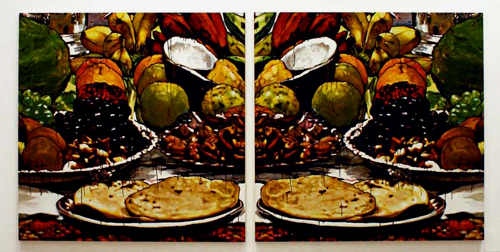
Holy Supper
Tomoaki Ishihara who does huge photographs of himself in front of well known works of art is also fun.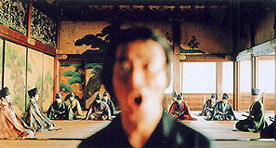
Self-Portrait, Nijo Castle
Look out for the Noritoshi Hirakawa series of women posed demurely in men's loos. I rolled my eyes but you may not.
I was looking at a sweet playful little piece of video art at the exhibition when L the lovely Tastenazi, informed me that some people are now building their houses around video art in their collection. Her description of her favourite, a house with a pool built around a light tree made it sound like it was silent art... unlike the pieces I heard drove their owners crazy (because its insane to have your walls talking to you all the time but whats the point if you are going to switch it off as if it was a toaster?) The actual display of video art, the lavishness or elegance of the showcase, must be the only way in which a collector can set herself apart from anybody with a DVD burner. Proof of ownership is being sold as a perk of course in this crazy new world of art collection but that's just a joke. Here is assume vivid astro focus aka Eli Sudbrack's full room installation from 2003.
Here is a report of how it was sold. "To reproduce the whole installation, a collector would have to buy one of each element, at a total cost of $150,000. The defining elements—the installation's floor, walls, and ceilings—were in an edition of three. But the five sculptures, priced at $5,000-$15,000, were in an edition of five while the $2,500 decals and $5,000 video were in an edition of 10. Thus, the total list price of products available from the Whitney show was $600,000, minimum."
Of course it was all sold. Most of this gives me a headache to think about. Though I did think it was coolwhen the owners of a Banksy mural put it up for sale and included their house (free) as part of the deal. They prefered that to prospective owners of the house whose first demand was that the mural be painted over before they moved in. Oh you prosaic darlings.

Jamil Baluch's sculptures in front of Pakistan's new National Art Gallery
Waseem Ahmed's Burqa
Aisha Khalid's Silence with Pattern
Vanessa Beecroft and why art is the coolest joke ever
0 comments Posted by The Chasing Iamb at 10/10/2007

Who's going to point out that the empress has no clothes?
Notice (do do check out the performances on her website) that nothing has changed in 13 years.

